

Application: Coat roof, façade, window and door components with liquid coatings
Coating tasks in the construction supply industry
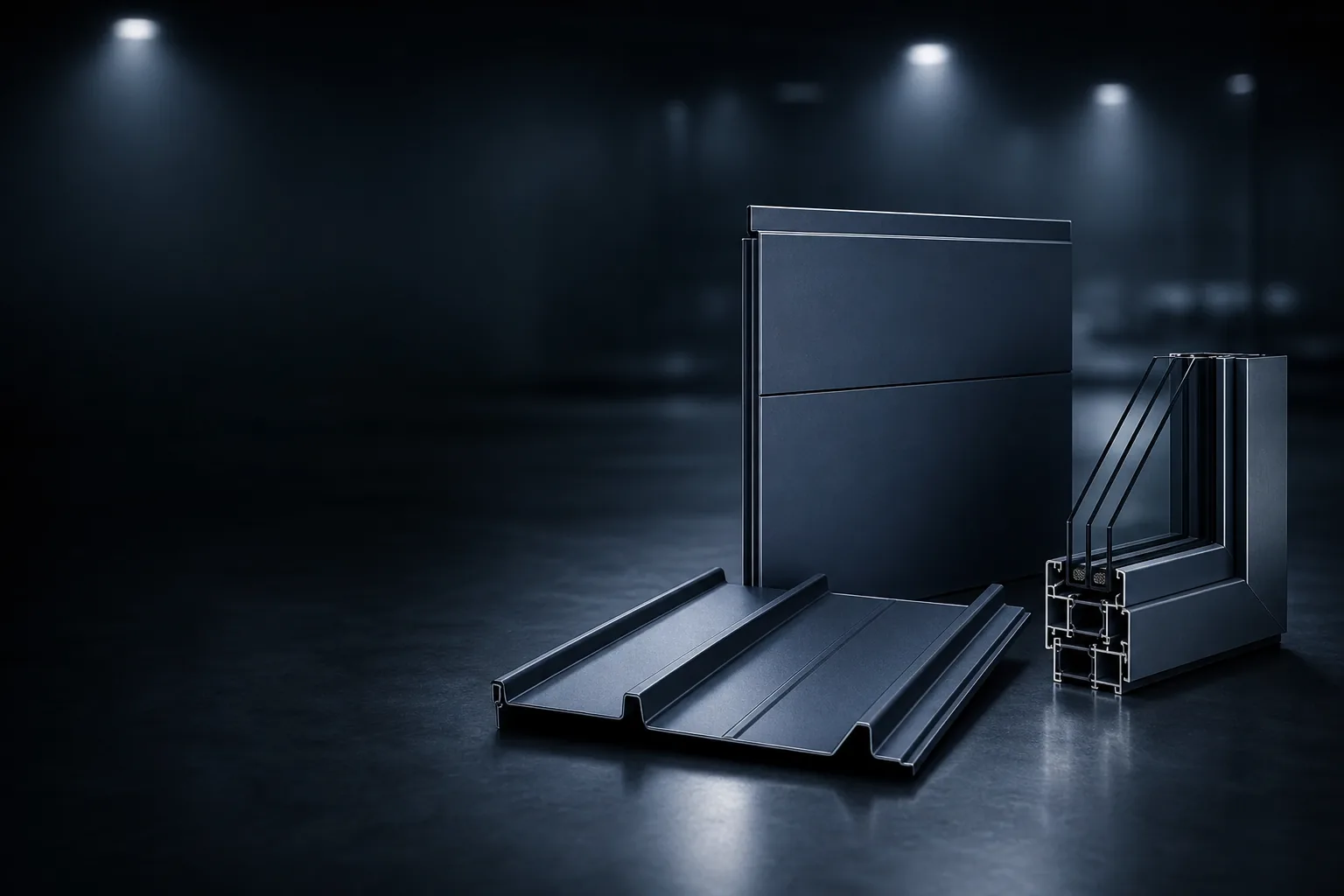
Roof and façade elements, window and door profiles, and other building components receive coatings to define their appearance and protect against weathering, moisture, corrosion or mechanical stress. Depending on the material and process, primers, adhesion promoters, topcoats, clear varnishes or functional protective layers are used.
This page refers to liquid coatings and wet coating processes. Spray technology can be used for serial components as well as for special formats, repairs, edges, cut-outs or targeted sections.
Long components and complex profile geometry
Profiles and edged elements have grooves, bridges, edges, folds and back trimmings. An even spray pattern on the visible surface is therefore not sufficient. The application must also capture relevant edge and geometry areas without overburdening holes with material.
For long components, variations in transport speed, distance or material pressure directly affect the layer. A repeatable positioning and a stable material supply are therefore important prerequisites for even results.
Typical coating tasks
- Priming and painting of window and door profiles
- Coating of roof, facade and cladding elements
- Edge, cut and repair painting
- Corrosion protection on metallic components
- decorative paint, gloss and effect coatings
- Protective layers on prefabricated construction components
Coating structure and component variants
Components can be made of steel, aluminium, plastic, wood material or composite material. This results in different requirements for cleaning, pretreatment, primer and topcoat. In the case of already coated components, it must also be checked whether the new varnish is compatible with the existing surface.
In production, profile cross sections, lengths and viewing sides change. A flexible bracket and a reproducible recipe for spray spacing, angles and amount of material facilitate the conversion. With large facade panels, several devices can work in parallel; with narrow profiles, targeted alignment is more important than a maximum spray width.
- Material and existing coating structure
- Visible side, back and relevant edges
- Change of profile and reproducible recipes
- Number and position of spray guns
- Coordination with conveying technology and drying
Krautzberger solutions for spray application and material supply
Manual spray guns can be used for individual parts and small series. In continuous or indexed lines, several automatic spray guns can be arranged in such a way that wide surfaces, edges and profile sides are coated in a defined sequence. Flat beam suitable for larger surfaces; Circular beam or specifically positioned apparatus can reach narrow and deeper areas.
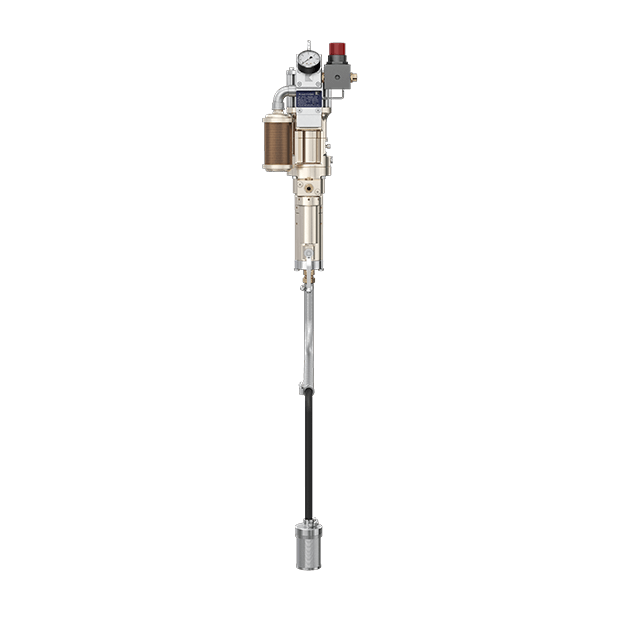
Material pressure vessels, diaphragm pumps, pump lifting stations and material pressure controllers are adapted to the quantity of paint, viscosity and pipe length. In case of frequent colour changes, material change valves and flushing systems support a quick change.
Decisive process parameters
For a durable result, substrate, pre-treatment, lacquer structure and drying must fit together.
- Component speed and spray distance
- Overlapping of the spray webs
- Edge cover and avoidance of runs in grooves
- Viscosity, material pressure and atomizer air
- Wet layer thickness and flash-off time
- Color change, cleaning and recovery or disposal of residual material
Manual rework and automatic serial coating
Not every coating process requires a fully automatic system. Individual pieces, samples, repairs and difficult-to-reach edges can be processed economically with manual spray guns. With recurring profiles or large quantities, automatic spray guns ensure smoother paths and better repeatability.
Krautzberger can consider both process types within a solution. This allows automatic main surface coating and manual reworking to be combined without completely separate systems for material supply and nozzle technology.
- Flexible machining of small and large batch sizes
- manual edge and repair painting
- automatic coating of recurring profiles
- common material supply for several jobs
Benefits for your production
- uniform coating of long and profiled components
- Flexible adaptation to different cross-sections
- Controlled edge and partial surface coating
- reduced overspray and material consumption
- manual and automatic solutions
- Integration into existing conveying and painting systems
Process tests in the Krautzberger technical test centre
Component geometry, varnish, pre-treatment and desired surface quality determine the appropriate application. Original coating material and sample profiles can be tested in the technical test centre. Nozzle arrangement, spray pattern, material pressure, movement and overlap are coordinated.
The subsequent adhesion, corrosion and weather testing is carried out according to the specifications of the customer and the paint manufacturer.
Related products
All products

Matching coating solution for your components
Are you looking for a paint gun, automatic spray guns or a complete material supply for roof, facade, window or door components? Krautzberger supports you with the technical design.
Talk to us about material, profile, lacquer structure, quantity and existing system.
Industries for this application
Roof and façade elements as well as window and door profiles must be visually convincing and withstand external influences. Whether primer, top coat or protective layer is required depends on the material and the later use of the component.
