

Aplicación: Spray release agents precisely and economically
Release-agent application as an important part of production
Release agents prevent a material from adhering to a mould, tool or process surface during forming, heating or curing. A clean release film supports reliable demoulding, protects the tool surface and can significantly affect the quality of the manufactured component. A thin, continuous film that is repeatable across the surface is crucial, rather than the largest possible application quantity.
Depending on the process, water- or solvent-based, oil-, wax- or silicone-containing systems as well as conventional or semipermanent release agents are processed. These media differ significantly in viscosity, surface tension, solids content, drying and residue formation. Therefore, the spray technology has to be adapted to the original material and the real process conditions.
Typical industrial applications
Release agents are used across industries. They are used both in cold tools as well as in heated moulds and in indexed high-performance processes. Typical applications are:
- Plastic, polyurethane and foam moulded parts
- Rubber and elastomer processing
- Fiber composite and composite components
- Die casting, mould casting and hot forming with suitable media
- Concrete moulds, forms and prefabricated parts production
- Foundry, core and model processes
- Woodworking, pressing and laminating processes
- Baking moulds and food processes with release agents released accordingly
What makes a good release film
Too little release agents can lead to adhesions, damaged components and increased cleaning effort. An excessive application, on the other hand, causes material consumption, deposits and impurities. Residues may also affect subsequent painting, bonding or sealing processes. The aim is therefore to achieve a defined amount of film, which is also reliably achieved at edges, radii and deepenings.
- even wetting without drops, puddles or dry areas
- constant application quantity for each spray cycle
- as low as possible overspray and a clean plant environment
- controlled ventilation or drying time before the next process step
- good accessibility of complex shape geometries
- rapid cleaning and rinsing during material or product changes
Decisive process parameters
Tool temperature, cycle time and carrier medium significantly influence the application. In the case of water-based release agents, sufficient time must be available for evaporating the water. Solvent-containing systems place other requirements on exhaust air, explosion protection and material resistance. In semi-permanent systems, an even structure of the separation layer is also important in order to achieve several demoulding cycles.
Nozzle size, spray distance, atomizer air, material pressure and motion path are adjusted in such a way that the necessary film quantity is applied without unnecessary fogging. In warm forms, evaporation and possible cooling of the tool surface must be taken into account.
Conventional and semi-permanent release systems
Conventional release agents are often applied at shorter intervals or before each cycle. Semipermanent systems can connect to the tool surface after aeration or curing and allow multiple deformations. This results in different requirements for basic application, after spraying and cleaning interval.
In semi-permanent systems, an uneven base film can cause variations in release performance. Conventional systems require very stable dosing over many short cycles. In both cases, the correct quantity matters more than applying as much as possible.
- initial application and maintenance coats
- Number of cycles between orders
- Ventilation or curing time
- Tool cleaning before reconstitution
- Avoidance of transfers to the component
Krautzberger spraying technology and material supply
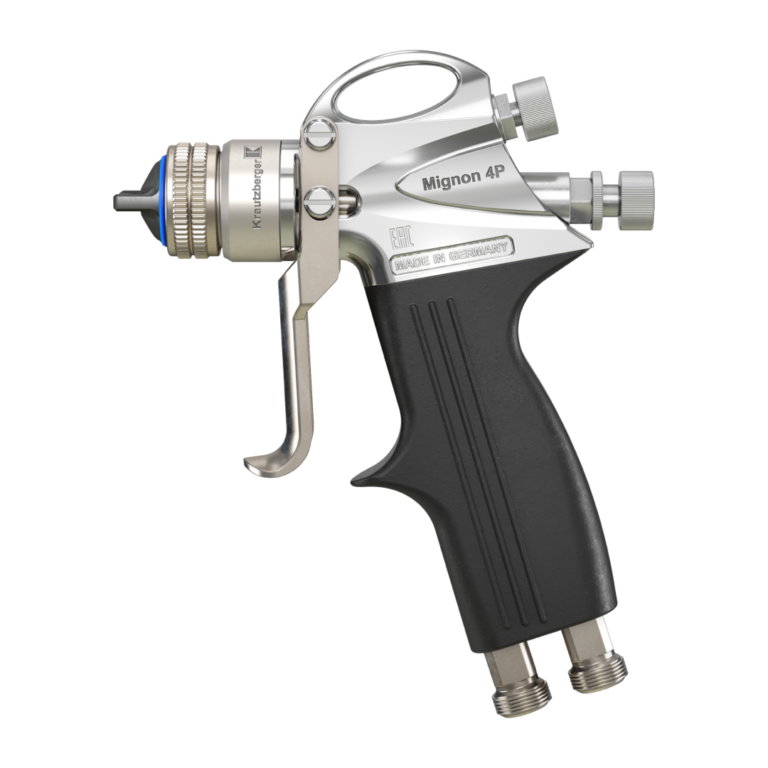
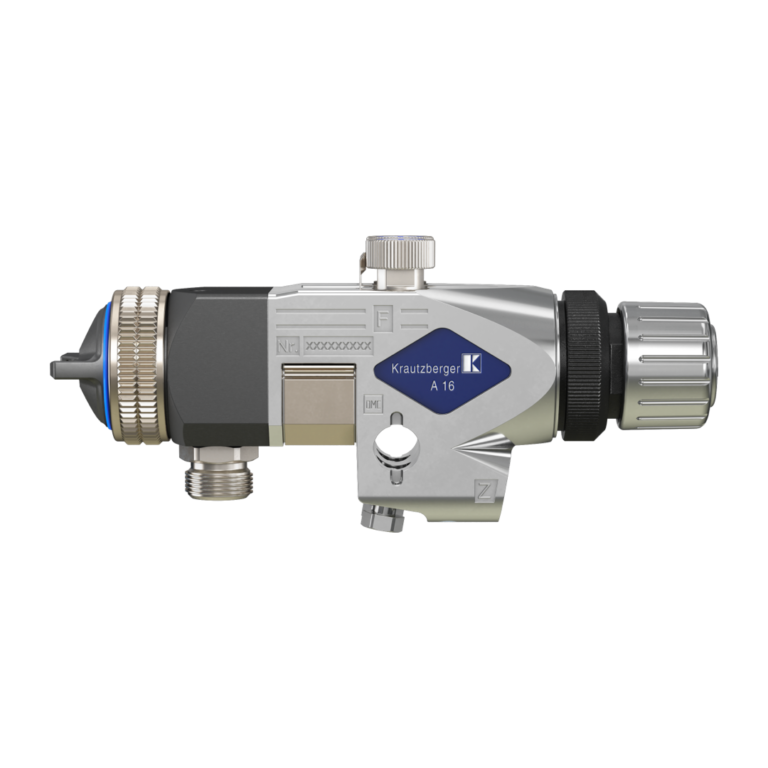
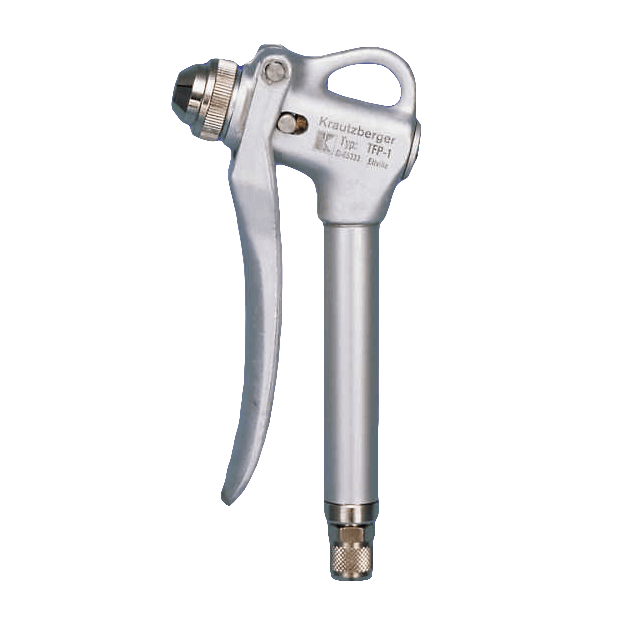
Manual spray guns and finely adjustable paint guns are available for manual processes. In automated production cells, compact automatic spray guns can be integrated on brackets, lifting devices, axes or robots. Flat and round jet nozzles, nozzle extensions and special spray directions help to wet even deep or difficult-to-reach molding areas.
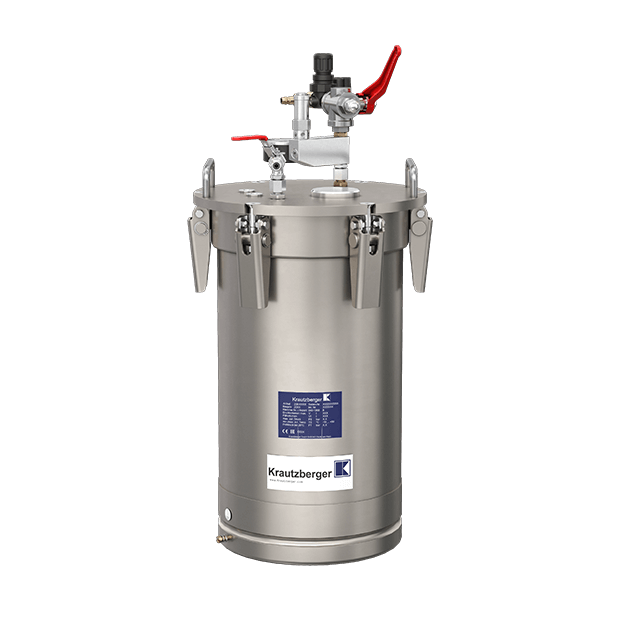
Depending on consumption, viscosity and system concept, the material can be supplied via material pressure vessels, diaphragm pumps or other suitable conveying systems. Material pressure regulators stabilize the pressure on the spray gun and support a reproducible application. Agitators may be required for sedimentating or solid media. Material exchange valves and rinsing options facilitate cleaning and media change.
Manual, automated or integrated into the forming system
With changing tools and small quantities, the manual application can be economical. In serial processes, an automatic spray sequence improves repeatability. Spray pulse, motion path and amount of material can be synchronized with tool opening, component detection or cycle time. This will only be sprayed if a mould is in the intended position.
In addition to the spray pattern, suction, transport, maintenance access and cleaning process must be considered for stable production. A good solution not only reduces consumption, but also prevents release agents from depositing uncontrollably on protective panels, sensors or grippers.
Advantages of a coordinated release agent application
- safe and reproducible deforming
- Lower release agent consumption
- less residue on tool and component
- reduced contamination of the production plant
- more stable cycle times and less rework
- Flexible adaptation to different media, tools and batch sizes
Tests with original release agent in the Krautzberger technical test centre
A robust design is only possible with the actual release agent and a representative shape or sample geometry. In the Krautzberger technical test centre, sprayability, wetting, film distribution, accessibility and cleaning behaviour are tested. The nozzle, spray pattern, material pressure, distance, spray time and motion can be coordinated.
The final deformation effect, material compatibility and release for the respective production process are evaluated together with the operator and the release agent manufacturer. Krautzberger supplies the right application and material supply technology for this.
Related products
All products

Suitable solution for your release agent process
Are you looking for a spray gun for release agents, an automatic spray gun, a pressure vessel solution or a complete material supply? Krautzberger supports you in the selection of nozzle, conveyor, pressure control and automation.
Get in touch with us and talk to us about release agents, tool geometry, temperature, cycle time and desired application quantity.
Industries for this application
Release agents prevent materials from sticking to tools and process surfaces when forming, heating or curing. A thin, closed and reproducible film is important in wood and furniture production as well as in construction suppliers.

