

Application: Reliably coat plastic components in series production
What this application is about
In practice, solutions range from flexible manual workstations to indexed, robot-assisted series-production systems. The spray equipment, material supply and movement sequence must be suited to the coating material and the workpiece.
Function and design of plastic surfaces
The application mainly concerns ABS, PC, PC/ABS, PA, PP, PE and other technical plastics after appropriate pre-treatment. The required effect occurs only when coating material, substrate, layer thickness and subsequent drying or curing fit together. The spraying process must therefore be adapted to the concrete material system and the real production conditions.
Alongside surface quality, material consumption, cleaning effort, system availability and reliable repeatability also matter. A sound technical solution therefore combines controlled atomisation with a stable material supply that is easy to regulate.
Typical requirements for the spraying process
Even small fluctuations in material pressure, viscosity, distance or movement control can change the coating visibly or functionally. Typical requirements include:
- secure adhesion to different types of plastics
- Avoiding electrostatic dust attraction without interpreting the process as an e-static application
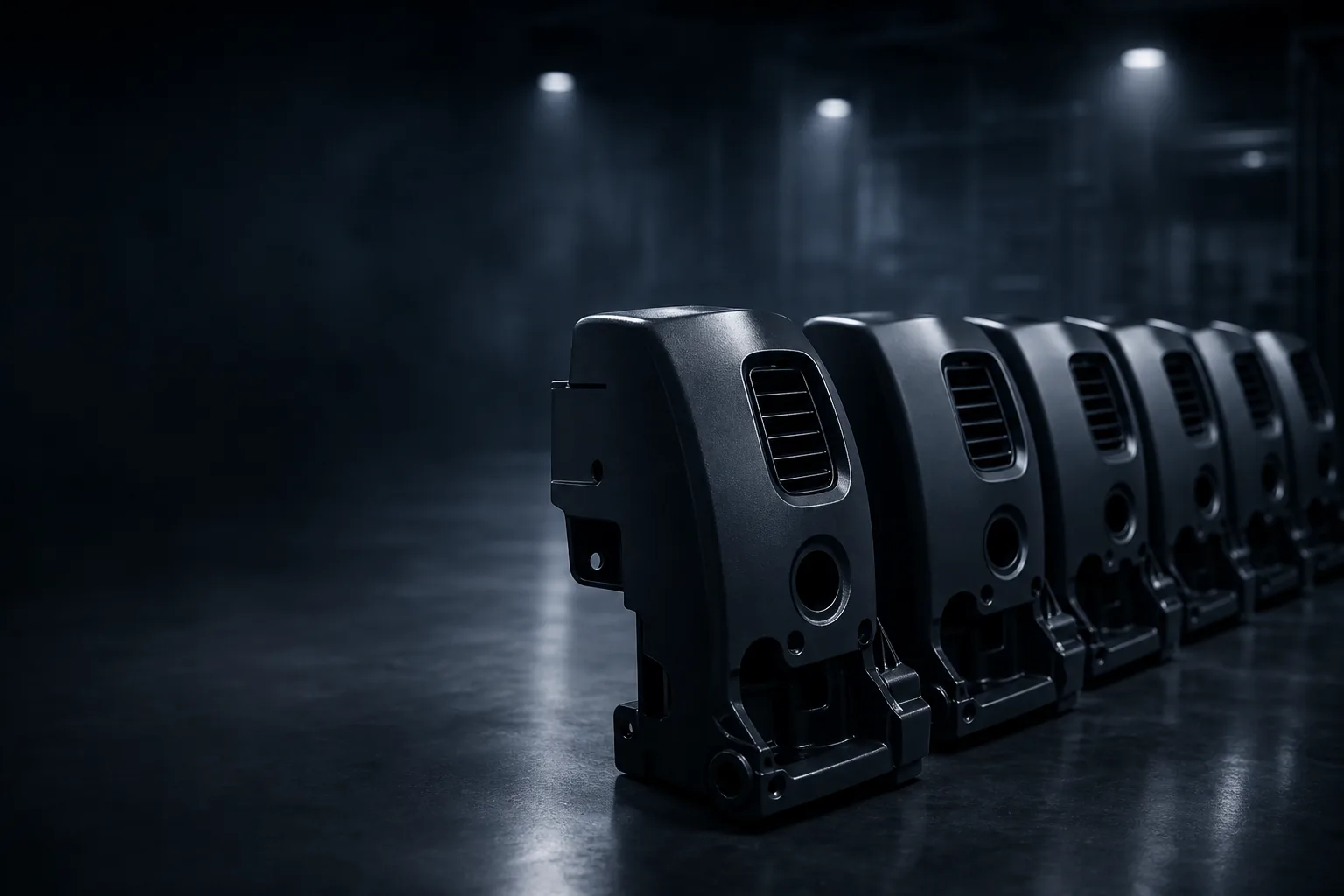
- even coating of complex injection molding parts
- optical defects on glossy or structured surfaces
- Masking of rest, sealing and functional areas
- high repeatability with short cycle times
Check surface energy and material compatibility
Plastics have very different surface properties depending on the polymer. Some materials require cleaning, activation or primer to ensure that the coating adheres safely. Solvents in paint must not attack the plastic or cause stress cracks.
In addition, static charge and dust can affect optical quality. The application is therefore considered together with pre-treatment, paint construction and component handling.
- Type of plastic and surface energy
- Pretreatment or primer
- Resistance to solvents
- Dust and static charge
- Edges, ribs and complex injection molding geometry
Krautzberger solutions for spray application and material supply
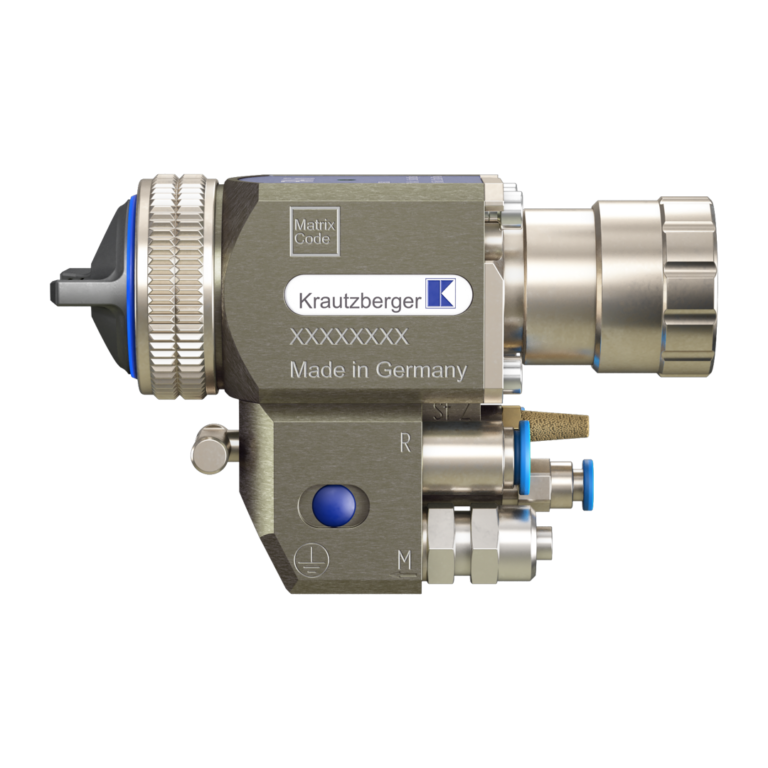
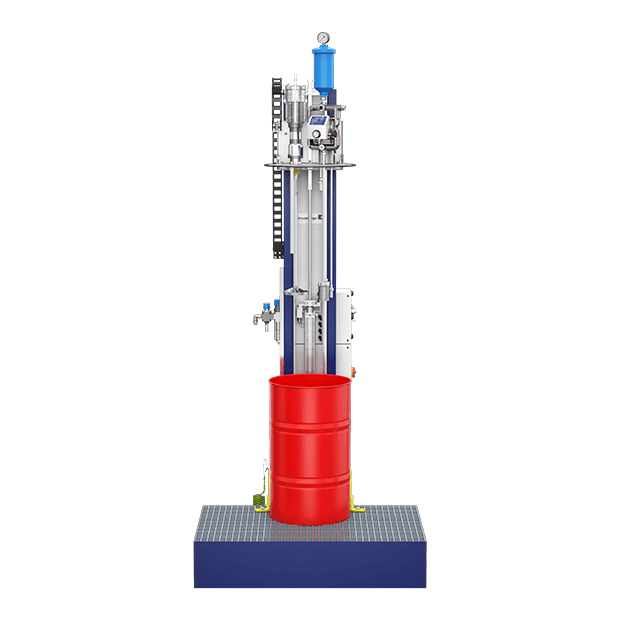
Krautzberger treats application and material supply as a connected system. Depending on the task, manual and automatic spray guns, suitable air and material nozzles, material pressure tanks, diaphragm pumps, pump and lifting stations, and material pressure regulators can be combined.
In automated processes, spray guns can be integrated into mounts, lifting devices, axes or robots. Material changeover valves and flushing equipment support applications with several colours or media. The specific selection depends on viscosity, solids content, application quantity, cycle time and component geometry.
For fine surface finishes, various XLINE nozzle combinations and spray patterns are available. With highly viscous, abrasive or sedimenting media, sufficiently large flow cross-sections, suitable material combinations, agitators and pressure-stable delivery become more important.
The focus is on finely atomizing hand and automatic spray guns, material pressure regulators, pumps or pressure vessels, robot adapters and in colour variations material change technology. The technically and economically suitable combination is selected for the specific medium, components and required production output.
Components, industries and fields of application
The application is used in different industries and component groups. Typical examples are:
- Automotive interior and control elements
- Electrical and electronic housings
- Household appliances and consumer goods
- medical equipment components
- Toys and model components
- Design and visual parts
Manual, partially automated or fully automatic
Pretreatment, cleaning and dedusting must be coordinated with the spray station. In the series spray webs, component rotation, cycle time and ventilation are reproducibly stored.
In addition, component feed, extraction or ventilation, cleaning, media change and accessibility for maintenance work must be taken into account during the system integration. This keeps the process stable not only in the pattern run, but also in everyday production.
Result for quality and economy
- high quality optical and functional surfaces
- even coating of complex moulded parts
- flexible adaptation to different plastics and varnishes
- reduced scrap due to stable process parameters
- economic use of materials
- simple integration in robot and continuous systems
Tests with original material and sample components
Liquid media and coating materials with similar names can differ considerably in viscosity, solids content, solvent base, wetting and drying. A reliable choice of spray gun, nozzle and material supply should therefore be made using the original material and a representative component.
Liability and material compatibility shall be tested on the original plastic; spray pattern, course and geometry cover shall be optimised in the technical test centre.
On this basis, the spray pattern, material quantity, pressure, distance, movement and cleaning sequence can be defined. The result is an application solution suited to the medium, the geometry and the intended production process.
Related products
All products


Contact for your application
Looking for a spray gun, an automatic spray gun or a complete material supply for this process? Krautzberger helps you select and design suitable spray technology, nozzle configurations, delivery and regulation.
Contact Krautzberger to discuss your medium, component, production volume and desired result. Together, we assess how the process can be implemented safely and economically.
Industries for this application
Uniformly coating plastic components in series production requires more than a suitable spray pattern: pre-treatment, coating system and cycle timing must be coordinated. In plastics and automotive manufacturing, these requirements apply to widely differing component shapes.

